AHU Design, Efficiency, and Quality – Properly Designing HVAC Systems and Operating Them Efficiently Over the Long Term
How can air handling units be designed and operated efficiently, in compliance with hygiene standards, and reliably over the long term? In this section, we explain key aspects related to energy efficiency, hygiene, outdoor installation, and the entire life cycle of an AHU - from design to modernization and recycling.
Today, modern AHU units can be equipped with highly efficient fans, heat recovery systems, heat exchangers, and cooling or heating units. However, the efficiency of a single component says little about how energy-efficient the entire ventilation and air-conditioning system will be during subsequent operation.
The key factor is the interplay between unit design, the ductwork system, heating and cooling supply, control systems, and the actual operating conditions. A high-quality AHU unit can only realize its energy-saving potential if the entire system is properly designed and operated according to demand.
As the efficiency of individual components increases, therefore, the importance of operational optimization grows. Modern model-based and model-predictive control systems can optimize the interaction of components and proactively adapt system operation to actual demand.
Where is energy required in an AHU unit?
The energy requirements of an AHU system consist of more than just the power consumption of the fans. Depending on the application and operating conditions, electrical and thermal energy are required for various tasks.
These include, in particular:
- Air movement via fans
- Heating of outdoor and supply air
- Cooling and, if necessary, dehumidifying the air
- Humidification when required
- Operation of refrigeration systems and heat pumps
- Pumps for heating, cooling, and heat recovery systems
- Controls, sensors, and other electrical loads
At the same time, an air handling unit can recover energy. A properly designed heat recovery system significantly reduces the heating or cooling requirements of the downstream air handling system.
For energy assessment, therefore, a single consumption value is not decisive. What matters is how much electrical and thermal energy the entire system requires over its actual operating time.
Why do pressure losses determine the energy requirements of the fans?
Fans must not only deliver the required air volume, but also simultaneously overcome all pressure losses within the air handling unit and the connected ductwork system.
Pressure losses occur, for example, at:
- filters
- Heat exchangers
- Heat recovery systems
- Silencers
- Dampers
- Air ducts, elbows, and fittings
A highly efficient fan alone therefore does not guarantee low power consumption. If it must constantly compensate for unnecessarily high pressure losses, the energy consumption of the entire system increases.
When planning, therefore, one should not focus exclusively on the efficiency of individual components. It is equally important to consider the pressure losses caused by these components and how the entire air duct system is designed.
Is heat recovery with the highest efficiency always the best solution?
A high recovery rate generally reduces the need for additional heating or cooling capacity. Nevertheless, a heat recovery system should not be selected based solely on a single efficiency rating.
Depending on the system, higher recovery rates may, for example, be associated with larger heat exchanger surfaces, higher pressure drops, or additional pump capacity. Space requirements, air transfer, humidity recovery, and the necessary separation of airflows also play a role in the selection process. It is therefore crucial to determine which solution enables the most energy-efficient and technically sound operation over the course of the entire year.
It is therefore crucial to determine which solution enables the most energy-efficient and technically sound operation over the course of the entire year.
We explain the different systems and their characteristics in detail in the Wiki article “Heat Recovery in AHU Units.” Why is part-load operation so important for energy efficiency?
Why is part-load operation so important for energy efficiency?
Many AHU systems operate at maximum design load for only a comparatively small portion of their operating time. Outdoor temperatures, occupancy, internal heat loads, and usage requirements are constantly changing.
Therefore, it is not only efficiency at the design point that matters. Equally important is how well fans, refrigeration systems, heat pumps, heat exchangers, and control systems can respond to different load conditions. Frequency-controlled fans and compressors, for example, allow their output to be adjusted to actual demand.
For example, variable-speed fans and compressors allow for adjustment of their output to actual demand. In the field of refrigeration technology, good part-load control can simultaneously reduce unnecessary cycling and enable a more uniform adjustment of output.
An energy-efficient design should therefore not only consider the maximum operating point, but also, as far as possible, the expected operating range of the system.
Why is a demand-based air volume such a major efficiency driver?
An AHU system does not need to deliver the maximum airflow at all times. In many applications, the actual ventilation demand varies considerably.
Typical factors influencing this include, for example:
- Occupancy
- CO₂ concentration
- Room temperature
- Humidity
- Production or process loads
- Hours of use
If the air volume is adjusted to actual demand, not only can fan energy be saved, but at the same time, less outdoor air needs to be heated, cooled, dehumidified, or humidified.
As a result, airflow control affects multiple energy consumers simultaneously. However, this requires that the AHU unit, air duct system, sensors, and control system be jointly designed for variable operation.
Why can an energy-efficient AHU unit still consume a lot of energy?
The technical efficiency of the built-in components initially describes only their capabilities. In actual operation, the control strategy determines when and at what capacity these components are actually used.
Unfavorable setpoints or operating strategies can, for example, result in: higher air volumes being delivered than are actually needed,
- airflow rates higher than actually needed,
- supply air is heated or cooled more than necessary,
- heating and cooling functions interact in an energy-inefficient manner,
- heat recovery is not utilized optimally,
- systems start earlier or run longer than necessary,
- components operate outside their optimal operating ranges.
A good control system therefore considers not only individual components, but also how they interact. The goal is not to operate a fan, heat exchanger, or compressor as efficiently as possible in isolation, but to achieve the required room or process conditions with the least possible overall energy consumption.
What are the limitations of a traditional AHU control system?
A conventional DDC control system typically operates using predefined setpoints, characteristic curves, time schedules, and control loops. It can thus operate an AHU unit reliably and already very energy-efficiently.
However, the challenge increases with the number of interdependent factors. Outdoor temperature, room temperature, humidity, occupancy, airflow, heat recovery, and heating and cooling capacity all influence one another.
If each control loop is considered primarily based on its current setpoint deviation, it is not automatically apparent which combination of different control variables is the most energy-efficient for the overall system.
Added to this is the temporal dynamics of a building. Rooms and building components store heat and, in some cases, react significantly more slowly than the AHU unit itself. A purely reactive control strategy takes future states into account only to a limited extent.
How can model predictive control make a difference?
Model-predictive control—often referred to as Model Predictive Control (MPC)—uses a model of the system being controlled to estimate its future behavior within a specific time horizon.
This allows the control system to evaluate various possible operating strategies before adjusting the corresponding control variables. Instead of reacting solely to a setpoint deviation that has already occurred, the system can be operated in a predictive manner.
A simple example is heating a building in the morning. Instead of starting every day at a fixed time with identical setpoints, a model-predictive strategy can take into account how the building and system are likely to develop under current conditions and when conditioning must actually begin.
The potential becomes even greater when multiple control variables are considered together. For example, a higher-level optimization can determine which combination of air volume, supply air temperature, heat recovery, and heating or cooling capacity is suitable for achieving the required conditions in an energy-efficient manner.
What role can artificial intelligence play in AHU control?
Model-based or model-predictive control is not automatically considered to be artificial intelligence. Various mathematical and physical approaches can be used for the required system or building model; these can be applied.
However, machine learning methods can help to map complex relationships from operational data and model the behavior of a system.
One example of this is etaSmart from HANSA etaTECH. It utilizes both neural networks and physically based models. The actual control of the AHU unit continues to be handled by the DDC. At a higher level, etaSmart can model the system and building behavior and optimise the operating strategy using model-predictive control.
This architecture has another advantage: The proven DDC control system remains in place as the fundamental unit level. The model-based optimization complements it rather than replacing all fundamental control functions.
We discuss the functionality and capabilities of such systems in more detail in the etaTECH Wiki.
Can intelligent control compensate for poor system design?
Even a very powerful control system cannot fully compensate for fundamental technical problems in an AHU system.
An undersized duct network, persistently high pressure losses, inappropriate heat exchangers, or an incorrectly designed heating and cooling supply remain physical constraints of the system.
Therefore, energy efficiency should not be viewed as a choice between efficient hardware and intelligent control. Both aspects build upon one another.
A well-designed AHU unit creates the technical prerequisites. A well-planned overall system prevents unnecessary energy losses. Finally, demand-based and, where appropriate, model-predictive control ensures that this potential is utilized as effectively as possible during actual operation.
Why should energy efficiency be considered over the course of an entire year?
Individual efficiency values or power consumption figures often refer to defined operating points. In contrast, a real AHU system operates throughout the year under very different outdoor and indoor conditions.
For a meaningful energy analysis, the following should therefore be taken into account, among other things:
- Operating hours and usage profiles
- varying outdoor air conditions
- Part-load and full-load operation
- Fan energy
- Heating and cooling energy
- Heat recovery
- Pumps and other auxiliary energy
- Control strategy and setpoints
HANSA designs and sizes customizable AHU units using the AirCalc design program. This program also integrates the life-cycle calculation from the AHU Manufacturers Association. This allows different unit configurations to be compared with one another during the design phase—not only based on individual technical parameters, but also in terms of their energy requirements over the operating period under consideration.
The energy analysis takes into account, among other things, the energy requirements for air movement as well as the energy required for thermal air treatment. This also reveals interactions: A technical solution, for example, may enable higher heat recovery, but at the same time cause higher pressure losses and thus higher fan energy consumption.
The life-cycle analysis therefore helps evaluate different equipment variants as an integrated system. The goal is not to achieve the maximum possible performance value for each individual component, but rather to find an overall configuration that makes sense, both technically and energetically, for the respective application.
Hygiene requirements for air-handling systems are particularly important in locations where the treated air is used for human comfort. In offices, schools, public buildings, and similar occupied spaces, the air-handling system should support a hygienically sound air supply and must not itself become a source of contamination.
Even higher requirements may apply in hygienically sensitive areas, such as hospitals and operating rooms, medically used rooms, laboratories, or cleanrooms. The specific requirements, therefore, always depend on the application of the AHU.
An important foundation for the hygienic design, construction, and operation of air-handling systems and units is the VDI 6022 series of guidelines. For particularly sensitive applications, additional standards, guidelines, and project-specific requirements may apply.
What does hygiene mean in the context of an AHU?
Hygienic air handling does not mean that the interior of an AHU for human comfort must be sterile. What is crucial is that the design and operation minimize hygienically undesirable conditions as much as possible. This includes, in particular, suitable materials and surfaces, filtration tailored to the application, easily accessible and cleanable components, and controlled management of moisture and condensate.
Hygiene is therefore not a property of a single component, but rather must be taken into account in the design and configuration of the entire air-handling unit.
What does VDI 6022 regulate?
The VDI 6022 series of guidelines addresses hygiene in ventilation and air-handling systems and units. The requirements begin as early as the planning and installation phases and extend through operation, maintenance, and hygiene inspections.
A key principle is that the ventilation and air-handling system itself must not deteriorate the quality of the air. This results in requirements for design, components, accessibility, cleanliness, and subsequent operation.
The central reference document is VDI 6022 Part 1. Depending on the application, other parts of the guideline series, as well as additional standards and regulations, must also be taken into account.
How is the hygienic design of an AHU verified?
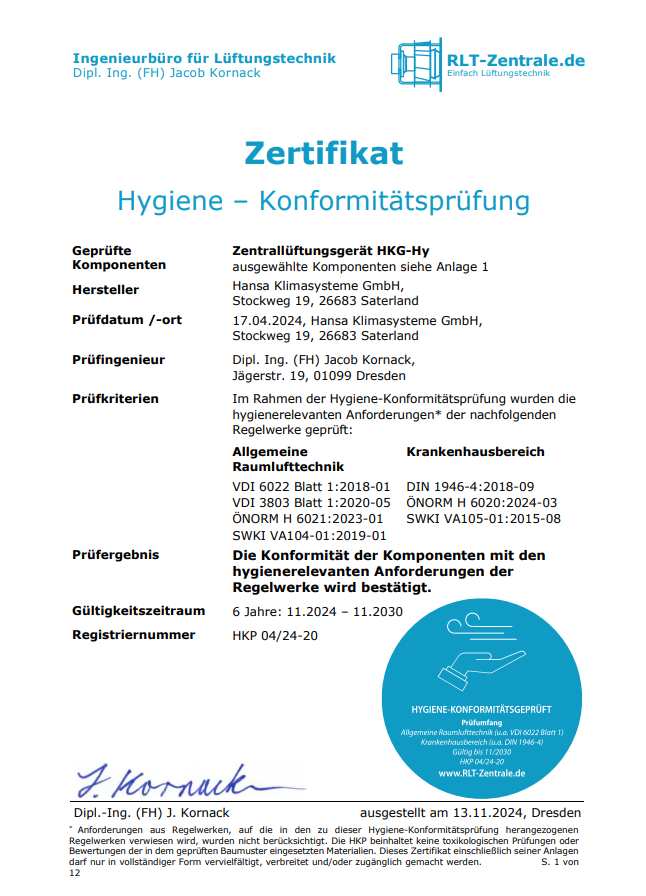
For AHUs with special hygiene requirements, the hygienic design should not be described solely by the manufacturer, but should be verified and documented based on the relevant requirements. To this end, a hygiene conformity test may be conducted by an independent testing laboratory or a qualified test engineer.
The assessment evaluates hygiene-relevant characteristics of the unit design and the components used. These include, for example, materials and surfaces, seals, accessibility, cleanability, filter arrangement, heat exchangers, and condensate drainage.
The result is documented in a corresponding certificate. This provides planners, operators, and building owners with verifiable evidence of the tested hygienic design.
The hygienic design of HANSA-Hy units underwent an external hygiene conformity assessment. The conformity of the tested components was assessed based on the underlying requirements of various regulations for general ventilation systems and hospital environments.
The hygiene certificate for HANSA-Hy units documents the underlying regulations and the tested unit design.
Which design features are critical for hygiene?
Many of the hygienic properties of an air-handling unit are already determined during its design phase. Materials and surfaces that come into contact with air must be suitable for the respective operating conditions and as easy to clean as possible. Accessibility is equally important. Filters, heat exchangers,
Accessibility is equally important. Filters, heat exchangers, fans, condensate areas, and other hygiene-relevant components must be accessible for inspection, maintenance, and, if necessary, cleaning. Maintenance doors, removable components, and sufficient maintenance areas
Maintenance doors, removable components, and sufficient maintenance space should therefore be taken into account during unit design and installation planning. At HANSA, the material and housing design can be adapted to the specific application.
We explain more about materials, leak-tightness, and corrosion protection in the article “Housing of Air-Handling Units”.
What role do filters, humidity, and condensate play?
Filters reduce particles and contaminants in the air being moved while simultaneously protecting downstream components from contamination. The required filter design depends on outdoor air quality, desired supply air quality, and the application.
Special attention must also be paid to areas where moisture is generated. For example, if air is cooled below its dew point at a heat exchanger, condensate forms. This must be collected and drained in a controlled manner without allowing standing water to remain in the unit.
Air humidification must also be integrated into the overall concept in a way that meets hygiene standards; the process, water quality, design, and maintenance must all be considered together.
We discuss the selection and arrangement of filters in more detail in the article “Filters in Air-Handling Units.”
Why does hygiene remain important even during operation?
Even an AHU designed to meet hygiene standards requires regular inspection and maintenance. Filters become clogged, heat exchangers can become contaminated, and condensate drains or other components may change from their original condition.
Hygienic quality is therefore not a characteristic that can be determined once during the commissioning phase and then simply assumed to remain in place. Regular checks and hygiene inspections help to identify changes early on and initiate necessary cleaning or maintenance measures.
With etaInspect, HANSA etaTECH offers services for the inspection of air-handling systems. This also includes the hygiene inspection, during which the hygienic condition of the system is checked and documented. This makes it possible to assess whether action is needed and what measures are required to ensure continued operation that meets hygiene standards.
What additional requirements apply in hospitals and hygiene-sensitive areas?
In hospitals and other areas with particularly high hygiene requirements, additional requirements may apply to airflow, filtration, pressure conditions, materials, cleanability, and operational safety.
Particularly demanding areas include, for example, operating rooms, intensive care units, sterile supply areas, as well as isolation and airlock areas. The required air-handling concept must therefore be planned based on the respective room function and the applicable requirements.
For such applications, HANSA offers the Blue Line Hy, a unit design specifically engineered for hygienically sensitive applications. The filter concept, materials, cleanability, heating and cooling supply, and control system can be tailored to the specific application.
For operating rooms, depending on the room and ventilation design, particulate filters or HEPA filters may be required. Filtration is always only one component of the overall hygiene concept.
For more information, see air handling Units for Hygiene and Hospital Areas .
What is crucial overall when planning for hygiene compliance?
Hygiene must be taken into account as early as the planning stage of the entire air-handling system. Key factors include, in particular, the requirements of the specific application, the filtration concept, suitable materials, moisture management, and accessibility for inspection, maintenance, and cleaning.
At HANSA, these requirements can be taken into account during the individual unit design process. Depending on the application, the following can be configured accordingly: housings, materials, filter stages, heat exchangers, humidification, heat recovery, maintenance access points, and control systems. Hygienic air-handling systems thus result from the interplay of
Hygienic ventilation systems are thus created through the interplay of: appropriate design, application-specific unit configuration, and continuously monitored operation.
Not every AHU can be installed inside a building. A lack of technical space, high airflow rates, or the building’s design may require installation on the roof or next to the building.
However, when installed outdoors, the AHU is exposed to the elements year-round. Rain, snow, wind, sunlight, frost, and fluctuating temperatures place additional demands on the enclosure, sealing, corrosion protection, and the overall system design.
Outdoor installation is therefore more than just an AHU with a weatherproof roof. As early as the planning stage, the location, airflow, foundation, drainage, frost protection, and future accessibility must be considered together.
What requirements does outdoor installation place on the AHU casing?
The enclosure forms the outer protective layer of the AHU. For an outdoor installation, it must permanently protect the internal components from the expected environmental conditions.
In addition to sufficient mechanical stability, the following are particularly important: airtightness, thermal insulation, the minimization of thermal bridges, and suitable materials and coatings. Doors, panel joints, feed-throughs, and other design details must also be engineered to be suitable for outdoor installation.
HANSA can manufacture AHUs with a housing design adapted to the location of use. This includes, among other things, different materials, coatings, and corrosion protection classes, as well as weather-resistant structural designs.
We explain the basic design and properties of the HANSA housing in more detail in the article “Housing of Air Handling Units”.
How is an air-handling unit protected from rain and snow?
Precipitation must not be allowed to enter the AHU unchecked, either through the housing or through the outdoor air and exhaust air openings. Therefore, the roof, joints, doors, connections, and penetrations must be designed accordingly. There’s a saying among air-handling specialists: “Water finds its way...”
For example, HANSA outdoor units feature a curved roof with a perimeter overhang or drip edge. This ensures that precipitation is systematically directed away from the unit’s housing.
Snow must also be taken into account during planning. Snow depths, snow drifts, and local conditions can influence the installation height, air inlets, and accessibility. The unit should be able to be safely operated and maintained even under winter conditions.
Why are outdoor air intake and exhaust particularly important?
The location of the outside air intake and exhaust air outlet affects both air quality and the operational safety of the system. Outdoor air should be drawn in at a location where the least possible amount of pollution from exhaust gases, exhaust air, dust, or other local sources of contamination is expected.
At the same time, it is essential to prevent exhaust air from being drawn back into the outdoor air intake in significant quantities. The position, distance, and orientation of the openings must therefore be planned on a project-specific basis. An incorrect design in this regard, also known as “short-circuit flow,” has an enormous impact on a unit’s efficiency.
For rooftop installations, local wind conditions, surrounding building structures, and potential air turbulence must also be taken into account. Rain and snow must also not be allowed to enter the system unchecked through the air openings; weather protection grilles or intake hoods must be provided.
What role do corrosion protection and site conditions play?
The stress placed on an outdoor unit depends heavily on its installation location. A unit in a relatively low-stress environment places different demands on materials and coatings than a system located near the coast, in an industrially polluted atmosphere, or in an environment with increased corrosive stress.
The required corrosion protection should therefore not be determined on a one-size-fits-all basis, but rather selected based on the actual environmental conditions. In addition to the unit housing, consideration must also be given to built-in parts, fasteners, heat exchangers, and other exposed components.
HANSA can manufacture housings and components from a variety of materials and with different finishes to suit the application. For particularly demanding environmental conditions, for example, enhanced corrosion protection requirements—including specially designed coatings in C5-H as well as stainless steel or aluminum versions—are possible.
What must be considered in the event of frost and condensation?
Outdoor units are exposed to significant temperature fluctuations. In winter, components and fluids can freeze, while in other areas, temperature differences can cause condensation.
Particular attention must therefore be paid to water-carrying heat exchangers, condensate lines, siphons, piping, and other areas susceptible to frost damage. Depending on the system design, suitable frost protection functions, insulation measures, or other technical protective measures may be required. Weather protection grilles may also need to be heated under certain circumstances to prevent frost formation and thus blockage of the intake.
Frost protection is not merely a feature of the unit’s housing. Hydraulics, control systems, and operating procedures must be integrated into the overall design.
What are the requirements for the foundation and installation surface?
An AHU requires an installation surface with sufficient load-bearing capacity and suitable conditions. For large units, significant dead loads and additional operational and environmental influences act on the structure.
The foundation or substructure must therefore be designed to suit the unit and the building. Among other things, the following must be taken into account: load distribution, levelness, required installation height, and the structural connection.
Drainage around the unit is also important. Rainwater and meltwater should be drained in a controlled manner and should not accumulate permanently in the area of the unit’s base or the maintenance access points.
For rooftop installations, the planning of the AHU must therefore be coordinated early on with the structural and building design.
Why must maintenance and accessibility be considered as early as the installation phase?
Even an outdoor unit must be able to be inspected, maintained, and, if necessary, repaired throughout its entire service life. Sufficient maintenance space must therefore be provided around the unit. Doors must open fully, and components such as filters,
Doors must open fully, and components such as filters, fans, or heat exchangers must remain accessible or removable. For rooftop installations, safe access routes and suitable work areas are also required.
Likewise, the planning phase should already take into account how larger components can be replaced at a later date. This applies in particular to systems whose installation location, once the building is completed, is only accessible to a limited extent.
A well-planned outdoor installation therefore takes into account not only the commissioning but also the entire subsequent life cycle of the AHU.
What are the key considerations when planning an outdoor AHU?
Outdoor installation should be an integral part of the unit and system planning from the very beginning. Retrofitting a unit originally planned for indoor installation to make it “weatherproof” is no substitute for a design that is appropriately engineered from the start.
Key planning considerations include:
- What weather and environmental conditions are to be expected at the site?
- What corrosion protection is required?
- How will outdoor air and exhaust air be routed?
- How are rain, snow, frost, and condensate accounted for?
- What are the requirements for the foundation and structural framework?
- Are maintenance and access areas sufficiently sized?
- How can components be maintained or replaced later?
With custom-designed HANSA AHUs, these constraints can be taken into account as early as the design and unit specification phase. Casing dimensions, materials, corrosion protection, roof design, air connections, and maintenance access points can be planned according to the specific installation situation.
An outdoor air-handling unit must therefore not only provide the required airflow. It must be designed as a complete system for its specific location and for safe, long-term operation.
An air-handling unit (AHU) is designed for long-term operation. Between the initial design and a subsequent retrofit, there are often many years of operation during which both the technical requirements and the use of a building may change.
The quality of an AHU is therefore not only evident at the time of commissioning. What matters most is how well the unit can be operated, maintained, adapted, and, if necessary, modernized over its entire life cycle.
Forward-looking planning takes this life cycle into account as early as the unit design phase. Accessibility, the interchangeability of components, control technology, and the possibility of later adjustments can significantly influence the long-term usability of an air-handling unit.
Why does the life cycle begin as early as the planning stage?
Many characteristics that determine the later operation of an AHU are already established during the planning phase. These include airflow rate, pressure drops, heat recovery, heating and cooling supply, filter design, control systems, and the unit’s structural design.
In this context, one should not focus exclusively on the maximum design point; typical partial-load conditions, operating hours, maintenance requirements, and potential changes in future use are equally important.
HANSA can design AHUs specifically for each project and adapt their construction to the respective installation situation and application. This allows the foundation to be laid already at this stage for efficient, long-term, maintainable operation.
What role does commissioning play?
Commissioning marks the start of the actual operation of the AHU. During this process, the planned functions are tested, and the system is adjusted to the intended operating conditions.
Appropriate setpoints and control parameters are particularly important. Even a technically highly efficient air-handling unit can consume an unnecessary amount of energy if, for example, airflow rates, temperatures, or operating times do not match the actual demand.
Experience is particularly crucial when it comes to custom-designed AHUs. HANSA units are commissioned by experienced commissioning engineers who are familiar with the units, their control systems, and the project-specific functions. This allows the operating modes specified during the planning phase to be tested on-site and adjusted to the actual system conditions.
Why are maintenance and inspection crucial for the system’s service life?
During operation, filters, fans, drives, heat exchangers, seals, and other components are subjected to various stresses. Contamination and wear can affect both operational reliability and energy efficiency.
Regular maintenance and inspection help to detect changes early on; filters can be replaced in a timely manner, heat exchangers can be cleaned, and worn or suspicious components can be inspected or replaced.
With etaInspect, HANSA etaTECH supports operators in inspecting air-handling systems. Depending on the requirements, this may also include specialized tests and hygiene inspections.
How do operational data help with long-term optimization?
A great deal of operational data is generated between two maintenance appointments. Temperatures, airflow rates, pressures, operating times, control variables, and energy consumption can provide insights into how a system is actually performing.
If this information is systematically analyzed, it can reveal, for example, unusual operating conditions, rising energy consumption, or opportunities for optimization.
HANSA etaTECH offers various solutions for this purpose: etaConnect enables the networking of and remote access to systems, etaVisu supports the visualization and analysis of operating data, and etaWatch enables the monitoring of energy consumption and energy-related metrics.
Operational data thus become an important basis not only for responding to malfunctions, but also for assessing the condition and efficiency of an air-handling system over the long term.
When does it make sense to modernize an AHU?
An older AHU does not automatically need to be completely replaced. Often, the housing and essential parts of the system can still be used, while individual components no longer meet today’s technical or energy efficiency standards.
In such cases, a retrofit can be an alternative to a complete replacement. Depending on the system’s condition, for example, fans, drives, heat exchangers, filter technology, control systems, or other components can be replaced or adapted.
Changing requirements can also be a reason for a retrofit. These include, for example, different airflow rates, new operating conditions, higher energy efficiency requirements, or modernized building automation.
With etaXChange, etaTECH evaluates existing air-handling systems for potential modernization measures. Which measures make sense depends on the technical condition, operating conditions, and future requirements of the respective system.
What happens to an AHU at the end of its service life?
Part of an AHU’s life cycle is the question of what happens to the unit and its components after the end of its technical service life. A design suitable for recycling should therefore be taken into account as early as the development and manufacturing stages.
HANSA units are designed so that, at the end of their service life, they can be easily disassembled into individual components and material groups. A large proportion of the components and materials used are metallic and can be directed to appropriate recycling channels.
To investigate practical recyclability, HANSA, in collaboration with its recycling partner Nehlsen, examined the disassembly and recycling of a representative HKG unit. For this purpose, a unit was completely disassembled on a trial basis, and the resulting materials were evaluated for their recyclability.
The study showed that, based on current technology, a recycling rate of approximately 85% is achievable. The actual rate for a specific unit may vary depending on the unit model, the components used, and the recycling processes available at the time of recycling.
Good disassemblability thus not only supports maintenance and upgrading during the service life but also facilitates the separation by material type and recycling at the end of the life cycle.
When does it make more sense to replace rather than modernize?
Not every existing system can be modernized in a way that makes economic or technical sense. A complete replacement may be particularly worth considering if significant parts of the unit are severely worn or damaged, or if the existing design can no longer meet future requirements.
Significant changes in airflow capacity, usage, hygiene, heating and cooling supply, or energy efficiency can also lead to a situation where a new unit design makes more sense than an extensive modification of the existing unit.
The decision should therefore not be based solely on the age of the system. The decisive factors are the actual technical condition, the remaining service life, and the requirements for future operation.
Why should the entire life cycle of an AHU be considered?
The investment in an AHU is only one part of its long-term overall assessment. Over many years of operation, additional expenses arise for energy, maintenance, replacement parts, repairs, and potential upgrades.
Therefore, even during the planning phase, it is worthwhile to consider not only the purchase price and technical specifications but also energy consumption, maintainability, and long-term adaptation options. During ongoing operation, inspections and operating data help assess the actual condition of the system.
A good long-term air-handling concept therefore combines the appropriate equipment design with controlled operation and the ability to modernize the system in a targeted manner as requirements change.