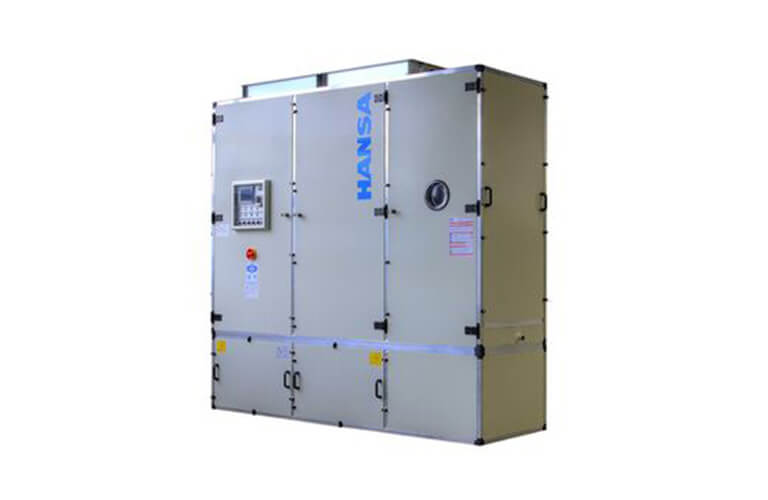
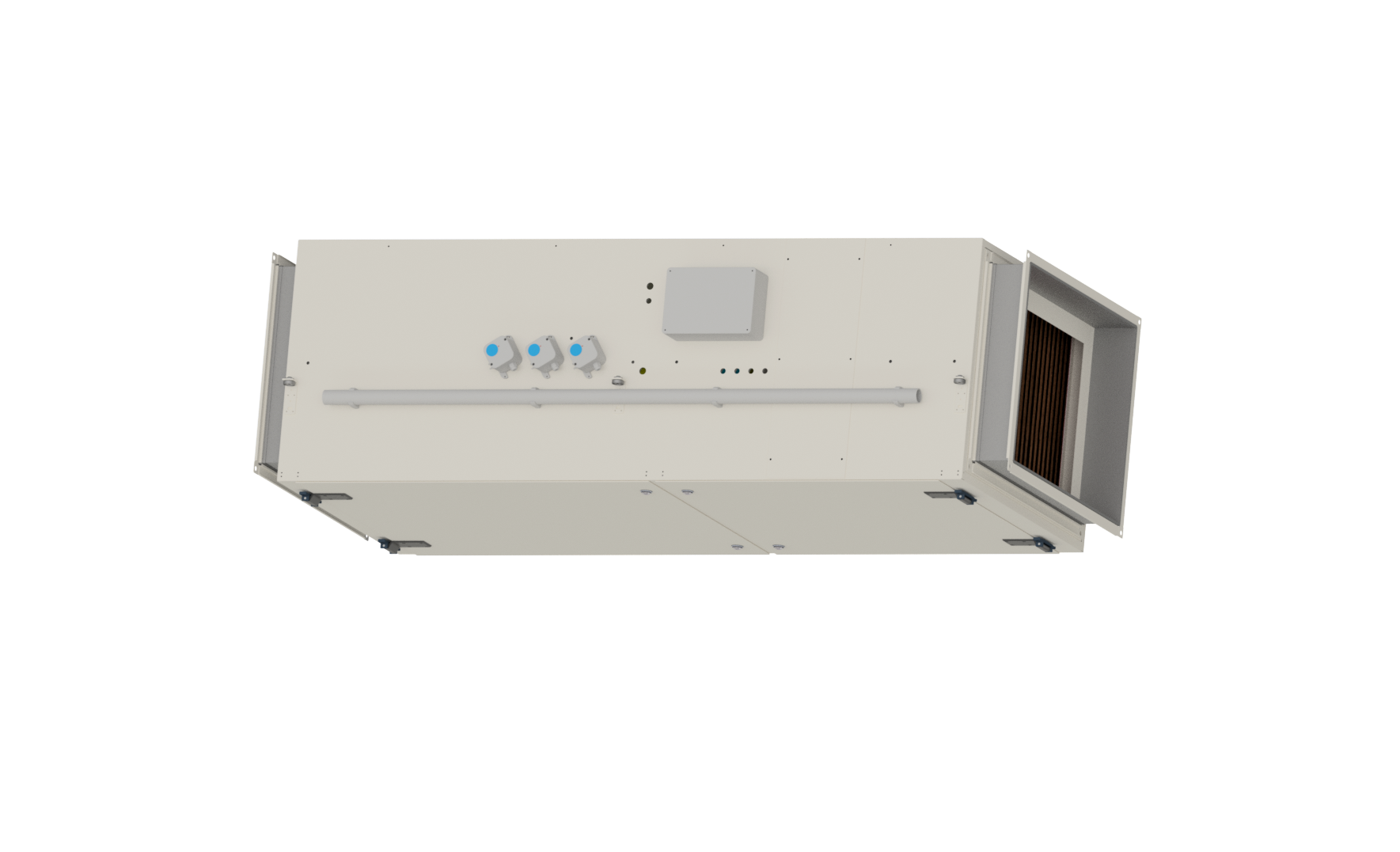
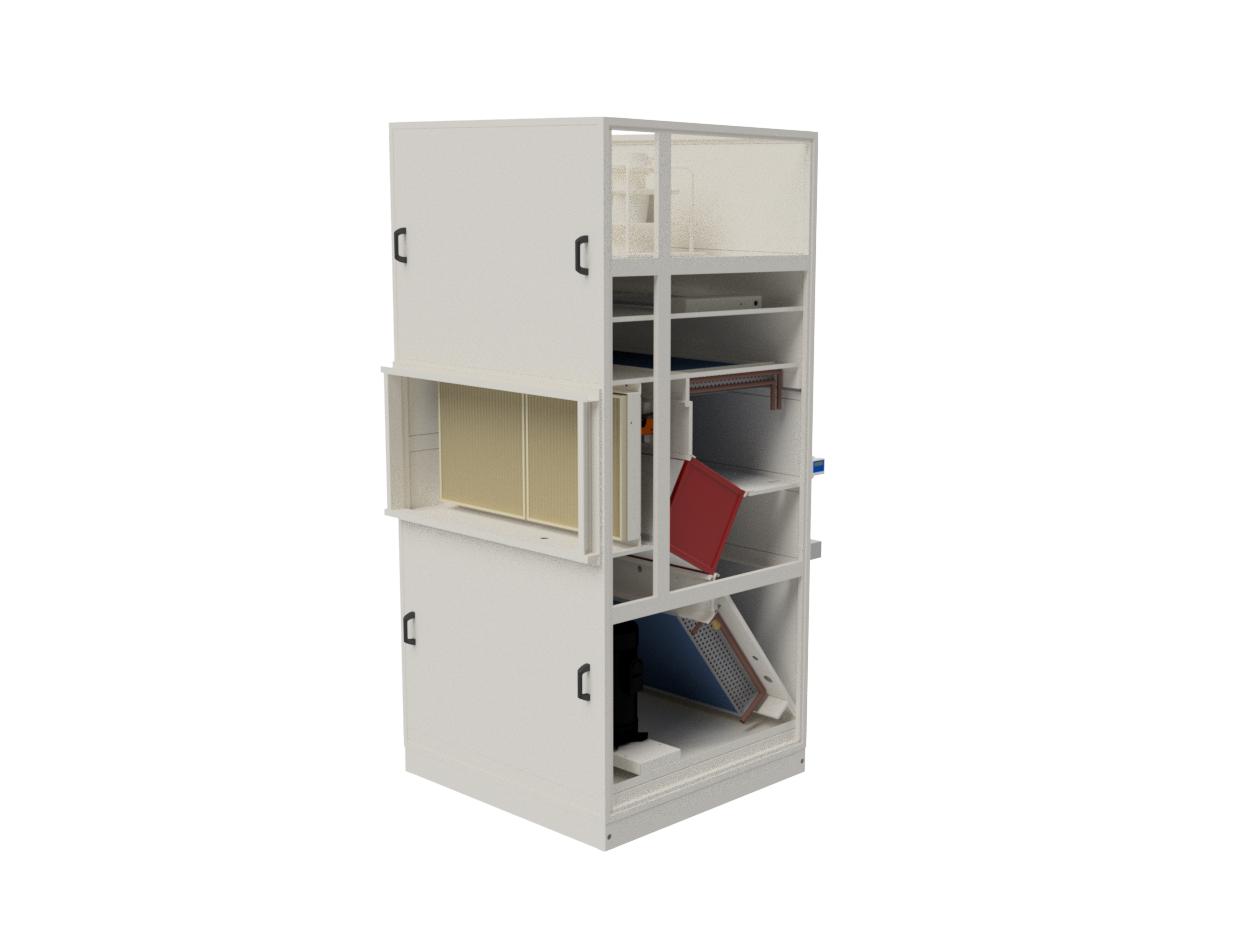
Blue Line Air Handling Units
Customised ventilation and air conditioning units for demanding HVAC applications.
Blue Line stands for custom-configured ventilation and full-featured air conditioning units in proven HANSA quality. The units are designed specifically for each project and optimized for the respective air conditioning task in accordance with applicable standards and guidelines.
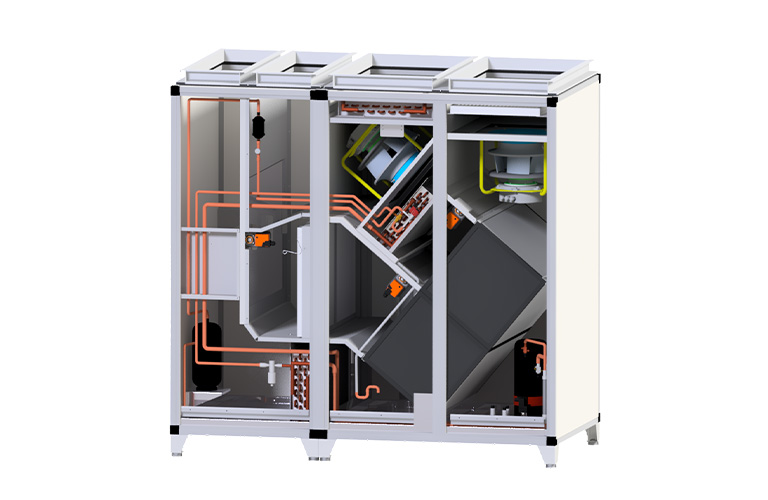
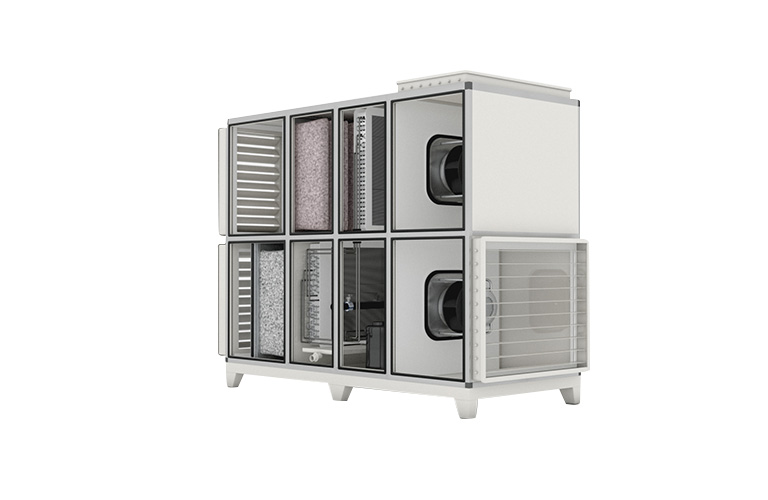
Various heat recovery systems, as well as functions for filtering, heating, cooling, humidifying, and dehumidifying, can be individually combined. Integrated refrigeration and heat pump technology, as well as the complete measurement, control, and regulation technology, can also be incorporated into the unit.
With air flow rates of up to 65,000 m³/h—and even higher depending on project-specific conditions—the Blue Line covers a broad spectrum ranging from building air conditioning to demanding industrial and process applications.


Blue Line at a Glance
| Feature | Blue Line Air Handling Units |
|---|---|
| Unit Concept | Custom-configured ventilation and full-featured air conditioning units |
| Unit Dimensions | Project-specific based on airflow capacity, components, and installation conditions |
| Airflow | Up to 65,000 m³/h; above that, customized for each project based on the specific conditions |
| Air handling | Filtering, heating, cooling, humidification, and dehumidification |
| Energy recovery | Plate, counterflow, double-plate, and rotary heat exchangers, Accubloc, and combined circulation systems |
| Refrigeration | External refrigeration supply or integrated refrigeration system |
| Heat pump operation | Reversible heating and cooling depending on the system design |
| Enclosure quality | Depending on the model, up to T2 / TB1 / D1(M) / L1(M) |
| Corrosion protection | Project-specific up to C5-H; stainless steel and aluminum versions available |
| Installation | Indoor installation, outdoor installation, or rooftop unit |
| Control & Automation | In-house MSR, DDC, and control panel technology |
| Special designs | including hygienic designs, custom section divisions, and special dimensions, ATEX |
Blue Line Models – Tailored to the HVAC Application
Blue Line can be configured with various heat and energy recovery concepts. The choice of system depends, among other factors, on airflow rates, energy requirements, space constraints, pressure conditions, and the necessary separation of airflows.
In addition, ASB+ offers a solution for indirect adiabatic cooling, and Blue Line Hy provides a special version for hygienically sensitive applications.
A brief explanation of terms:
PT: Cross-cross counterflow
DPT: Double-plate heat exchanger consisting of two PT
units connected in series GS: Counterflow principle · high recovery rate · space-optimized design
Plate heat exchangers enable efficient heat recovery with effective separation of supply and exhaust air.
Blue Line offers various designs for this purpose, which are selected based on the required heat recovery, airflow capacity, installation situation, and other project requirements.
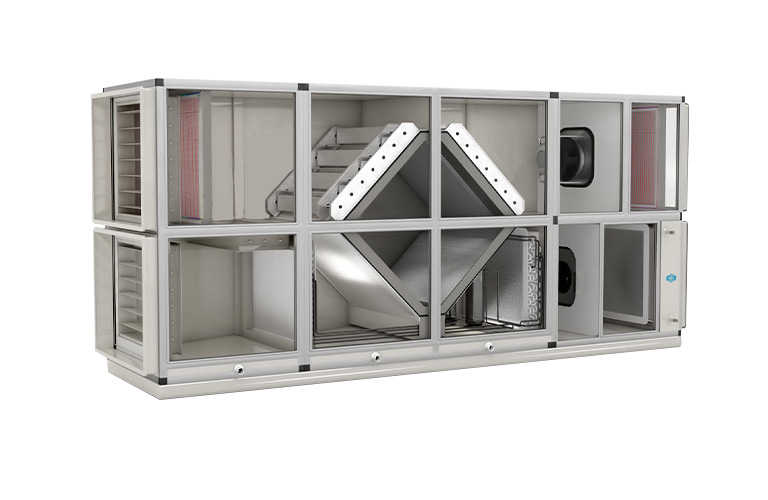
Blue Line PT and DPT utilize cross-flow and cross-counterflow plate heat exchangers, respectively. As static systems, these heat exchangers have no moving parts and are particularly robust under design conditions. Supply and exhaust air are routed through the plates in separate streams. Double-plate heat exchangers also form the technical basis for the Blue Line ASB+ with indirect adiabatic cooling.
Blue Line GS uses counterflow heat exchangers. This design combines high heat recovery with a comparatively small footprint, thereby enabling compact, space-optimized unit designs.
Depending on the application, the heat exchangers can be designed with enhanced corrosion protection or special coatings. Plate heat exchangers made of moisture-permeable materials for additional moisture transfer are also available.


Blue Line DPT in Winter Operation - Click it!
Blue Line ASB+ expands heat recovery using a double-plate heat exchanger to include indirect adiabatic cooling.
To achieve this, finely atomized fresh water is sprayed onto the exhaust air side. As the water evaporates, heat is extracted from the exhaust air, causing its temperature to drop.
The cooling capacity generated in this way is transferred to the outside air via the double-plate heat exchanger. The supply air does not come into contact with the water used for evaporation and is not additionally humidified.
Under suitable outdoor and exhaust air conditions, the outdoor air can be cooled by up to 12 K using ASB+. This reduces the need for mechanical refrigeration and results in corresponding savings in electrical energy.
Saving Energy – Considering Water Consumption
Indirect adiabatic cooling reduces the electrical energy required for mechanical refrigeration, but it does require fresh water for evaporation. Therefore, when evaluating energy efficiency and environmental impact, water consumption should be taken into account in addition to the electrical energy saved.
This becomes particularly important in light of regional water availability and prolonged dry spells. Whether ASB+ is the appropriate solution in terms of energy and resource use should therefore be evaluated based on the specific site and operating conditions.


Operator Responsibilities and Hygienic Operation
For systems with evaporative cooling, special attention must be paid to ensuring the hygienically sound operation of the water-carrying components. In connection with the 42nd BImSchV, the legal classification of indirect adiabatic cooling systems may depend on the specific design and operating mode of the system.
Operators should therefore determine, as early as the planning and commissioning phases, which hygiene-related monitoring, maintenance, documentation, and—if applicable—testing requirements apply to the specific system.
ASB+ Features at a Glance:
- Indirect adiabatic cooling on the exhaust air side
- Up to 12 K of outdoor air cooling under suitable conditions
- No additional moisture introduced into the supply air
- Reduced need for mechanical cooling
- Fresh water operation without complex water treatment, except in cases of high water hardness
- Mechanically robust, as the spray bar is rigidly mounted
Note: The achievable cooling capacity depends on the temperature and humidity of the exhaust air as well as outdoor air conditions. At the same time, water requirements and local water quality must be taken into account during planning.
Blue Line ASB+ in action - Click it!
Blue Line eco-R uses a rotary heat exchanger for regenerative energy recovery.
The rotating storage mass absorbs energy from the exhaust air and transfers it to the outside air. In the summer, this principle can be used for cooling recovery.
Depending on the rotor design and operating conditions, both heat and moisture recovery are possible. Rotors with a hygroscopic coating can specifically transfer moisture; additionally, moisture transfer can occur through condensation.
Rotary heat exchangers are particularly well-suited for high air flow rates and enable compact energy recovery. Blue Line eco-R is designed specifically for each project and can be delivered ready for connection with the HANSA control system.
Devices that use rotors for energy recovery are characterized by the following features:
- High energy recovery
- Heat and cooling recovery
- Depending on the rotor design, humidity recovery
- Particularly suitable for high airflow rates
- Compact design
- Demand-based control of rotor performance


Blue Line KVS enables heat recovery with completely separate supply and exhaust air streams.
Air-to-brine heat exchangers are used in both air streams. A brine solution absorbs the thermal energy and transports it via a closed hydraulic circuit to the other heat exchanger, where the energy is transferred back to the air stream.
Since there is no direct connection between the supply and exhaust air, this combined-cycle system is particularly well-suited for applications requiring strict separation of the air streams. At the same time, the supply and exhaust air units can be installed in separate locations. By design, the system is robust against varying pressure conditions between the air streams.
etaHydro – Hydraulics and Control for the Closed-Loop System
With etaHydro, HANSA offers the hydraulic station designed specifically for the closed-loop system. It hydraulically connects the air-brine heat exchangers and, together with the HANSA control system, manages energy recovery on demand.
etaHydro can be configured to include controls and, if required, can also be designed with redundancy. This allows HVAC units, hydraulics, and controls to be supplied as a fully integrated system.
Due to the complete separation of the air flows, the KVS is also suitable for applications with heavily contaminated exhaust air. For exhaust air in the ETA-4 category, a system with appropriate air flow separation is required.

An Overview of KVS/etaHydro Features:
- Complete separation of supply and exhaust air
- Spatially separate supply and exhaust air units are possible
- Robust performance under varying pressure conditions
- Suitable for applications with high requirements for airflow separation
- Used with ETA-4 exhaust air
- etaHydro hydraulic station with HANSA control
- Redundant etaHydro pump configuration available
- Demand-based brine pump control
- Energy data logging with heat meter
Note: Compared to directly coupled heat recovery systems a KVS requires an additional hydraulic circuit with pumps and control. The energy efficiency of the entire system therefore depends not only on the heat exchangers, but also on the coil design, pressure losses, hydraulics, and control strategy.
Blue Line Hy is the hygienic version of the Blue Line series, designed for applications with heightened requirements for hygienic safety in ventilation and air conditioning systems.
The units are designed on a project-by-project basis according to the specific application, the required air conditions, filter stages, and hygiene requirements.
The focus is not on a single component, but rather on the hygienic design of the entire HVAC unit. Components are arranged for easy access and to facilitate cleaning and disinfection. Components requiring frequent maintenance, such as refrigeration systems and humidifiers, can be arranged so that maintenance work can be performed outside of hygienically sensitive areas of the unit.
Depending on the application, various filter stages, heating and cooling functions, humidification, and suitable heat recovery systems can be integrated. The necessary measurement, control, and regulation technology is also tailored to the respective hygiene and room class.

Standards and Verified Hygiene Compliance
Blue Line Hy is designed in accordance with the hygiene requirements and regulations relevant to the specific application. These include, in particular, DIN 1946-4 for HVAC systems in healthcare facilities and rooms, as well as VDI 6022 for the hygiene of HVAC systems.
The hygiene compliance of HANSA’s equipment design is verified through an independent conformity assessment.
What sets the Blue Line Hy configuration apart:
- Equipment design suitable for cleaning and disinfection
- Easy access to the relevant components
- Project-specific filter concepts
- Heating, cooling, and humidification functions can be integrated
- Appropriate heat recovery systems in accordance with hygiene requirements and airflow separation
- In-house measurement and control, DDC, and control cabinet technology
- Storage and logging of relevant operating data
- Remote management via HANSA management systems
- Independently verified hygiene compliance
For applications with high requirements for the separation of supply and exhaust air, Blue Line Hy can be combined with a recirculation system and etaHydro.
Why Choose HANSA's Blue Line Air Handling Units?
It is not the unit that determines the solution—it is the application.
Blue Line is not a rigid product series with fixed unit sizes and functions. Dimensions, airflow patterns, components, and air-handling stages are configured on a project-by-project basis to meet the specific requirements of each HVAC application.
The Right System for Energy Recovery
Plate and counterflow heat exchangers, double-plate heat exchangers, rotary heat exchangers, or combined circulation systems: Heat recovery can be selected to meet energy requirements, air quality standards, space constraints, and the need for airflow separation. With ASB+, indirect adiabatic cooling is also available.
From ventilation to full air conditioning
Filtering, heating, cooling, humidification, and dehumidification can be individually combined within a single Blue Line unit. Integrated refrigeration and heat pump technology can also be part of the system design.
Design Tailored to the Specific Project
Indoor or outdoor installation, rooftop units, special access routes, custom section division, enhanced corrosion protection, or special material options can all be taken into account during the design phase.
Unit and Control System as a Complete Solution
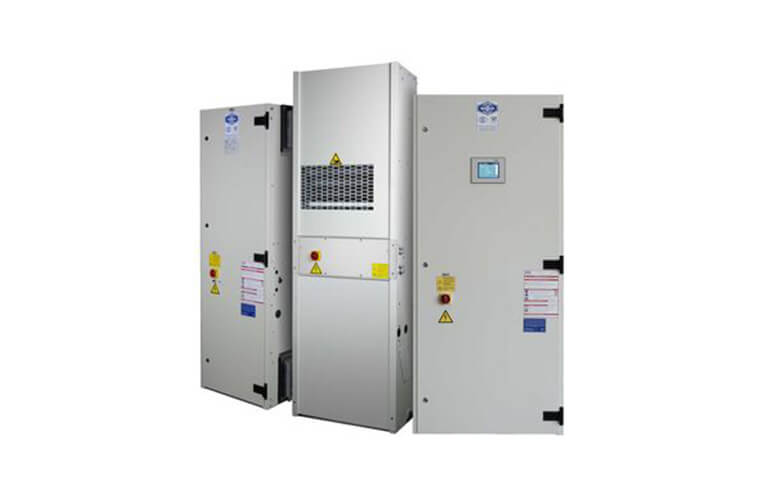
In addition to the air handling unit, HANSA also develops and manufactures control cabinet, measurement and control (MSR), and DDC technology. Refrigeration technology—and, for KVS systems with etaHydro, the hydraulics as well—can be integrated into the overall system. This allows the individual components to be coordinated with one another as early as the design and control phases.
Blue Line is therefore less of a single air handling unit and more of a platform from which HANSA develops the appropriate solution for the specific air-conditioning task.
Blue Line Air Handling Units in Use
The Blue Line units are as diverse as the requirements they meet.
The high degree of configurability allows for use in numerous areas—from comfort-oriented building air conditioning to demanding hygiene, process, and industrial applications. Depending on the application, airflow, heat recovery, filtration, temperature and humidity control, and other functions are individually tailored to the specific task. The Blue Line's areas of application:

Good to Know
The process begins with the specific HVAC task. Based on the requirements and structural constraints, designers and/or operators define the key parameters—such as the required air volumes and air conditions, the desired system and heat recovery concept, the installation location, and any special requirements for the unit.
HANSA uses this basic data to design the unit. As planning progresses, the configuration is refined in collaboration with project stakeholders through several iterative steps. Dimensions, components, air-handling stages, control systems, and other options are specified in detail until the technical configuration of the unit is finalized.
Once the order is placed, the Blue Line unit is manufactured and delivered according to this design. Installation and integration into the overall system are carried out in collaboration with the system integrator. HANSA then handles the commissioning and calibration of the unit’s functions and control systems.
Blue Line is not bound by a rigid grid of fixed unit sizes. Dimensions, airflow, sectioning, and components are designed on a project-by-project basis according to the required airflow capacity, the HVAC task, and the structural constraints.
This is particularly advantageous for retrofits, limited space for mechanical systems, or difficult installation routes. Units can be divided into suitable sections based on the installation situation and assembled on site.
That depends on the specific application. In addition to energy recovery, exhaust air quality, the need to separate airflows, pressure conditions, space requirements, and the desired moisture transfer all play a role.
Blue Line can therefore be implemented using a variety of systems—ranging from plate or counterflow heat exchangers to rotors and recirculating composite systems. What matters is not a single “best” system, but rather the solution best suited to the specific task.
Both options are possible. If a central cooling supply is available, Blue Line can be supplied via appropriate cooling coils. Alternatively, the cooling system can be integrated directly into the HVAC unit.
Which option makes the most sense depends, among other things, on the required cooling capacity, infrastructure, operating mode, and project requirements. With integrated systems, reversible operation for both heating and cooling can also be implemented, depending on the system design.
Blue Line can be configured for indoor or outdoor installation, as well as for rooftop installation. For outdoor installation or corrosive environments, the design, materials, and surface protection are selected to suit the site conditions.
Depending on requirements, corrosion protection up to C5-H as well as stainless steel or aluminum versions are available. This allows Blue Line to be configured for even the most demanding industrial or maritime environments.
These classes describe different properties of the HVAC enclosure. T rates the thermal transmittance, TB the thermal bridge factor, D the mechanical stability or deflection, and L the airtightness of the enclosure.
Depending on the housing design, Blue Line achieves ratings of up to T2 / TB1 / D1(M) / L1(M)—Eurovent-tested. The required housing quality is selected based on the application and project requirements.
Yes. HANSA can supply HVAC units, control cabinets, measurement and control equipment, and DDC as a coordinated, integrated system. The system can be integrated into a higher-level building or process control system via appropriate interfaces.
With etaConnect and etaVisu, operational data can also be collected, visualized, and made available for remote access, analysis, and service.