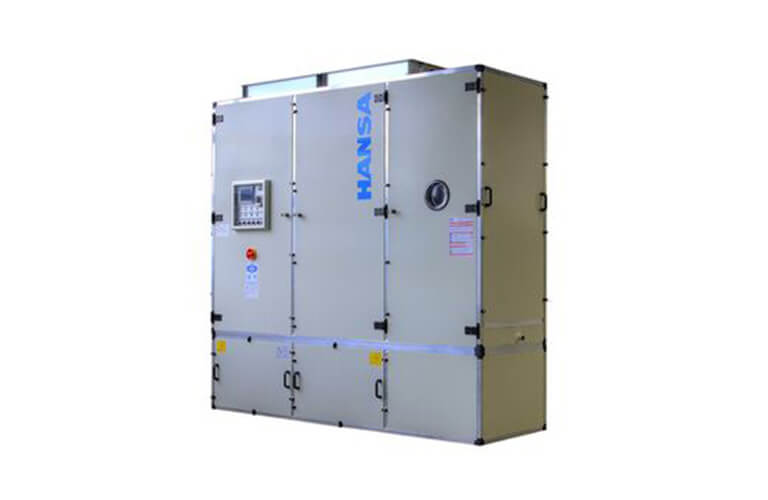
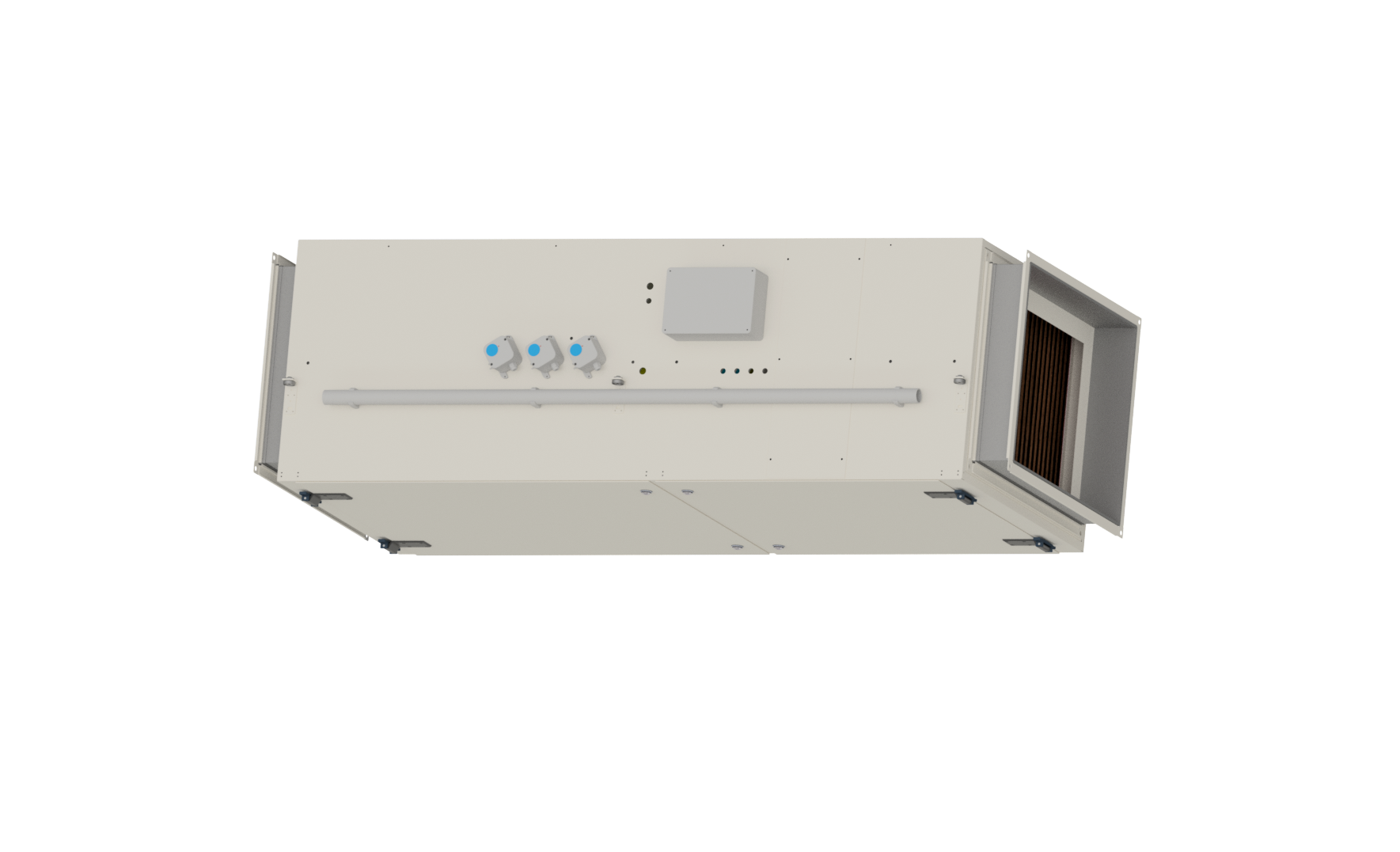
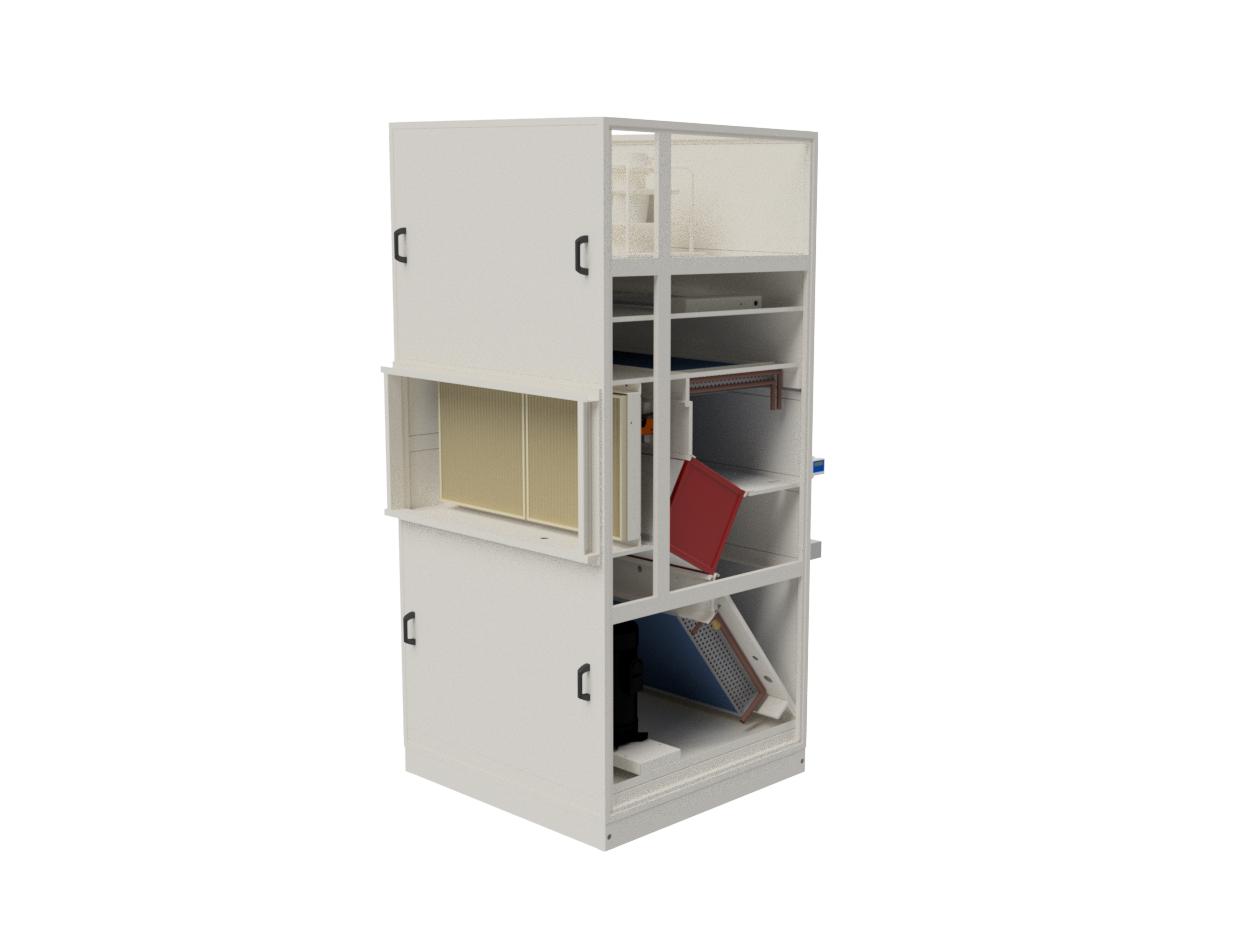
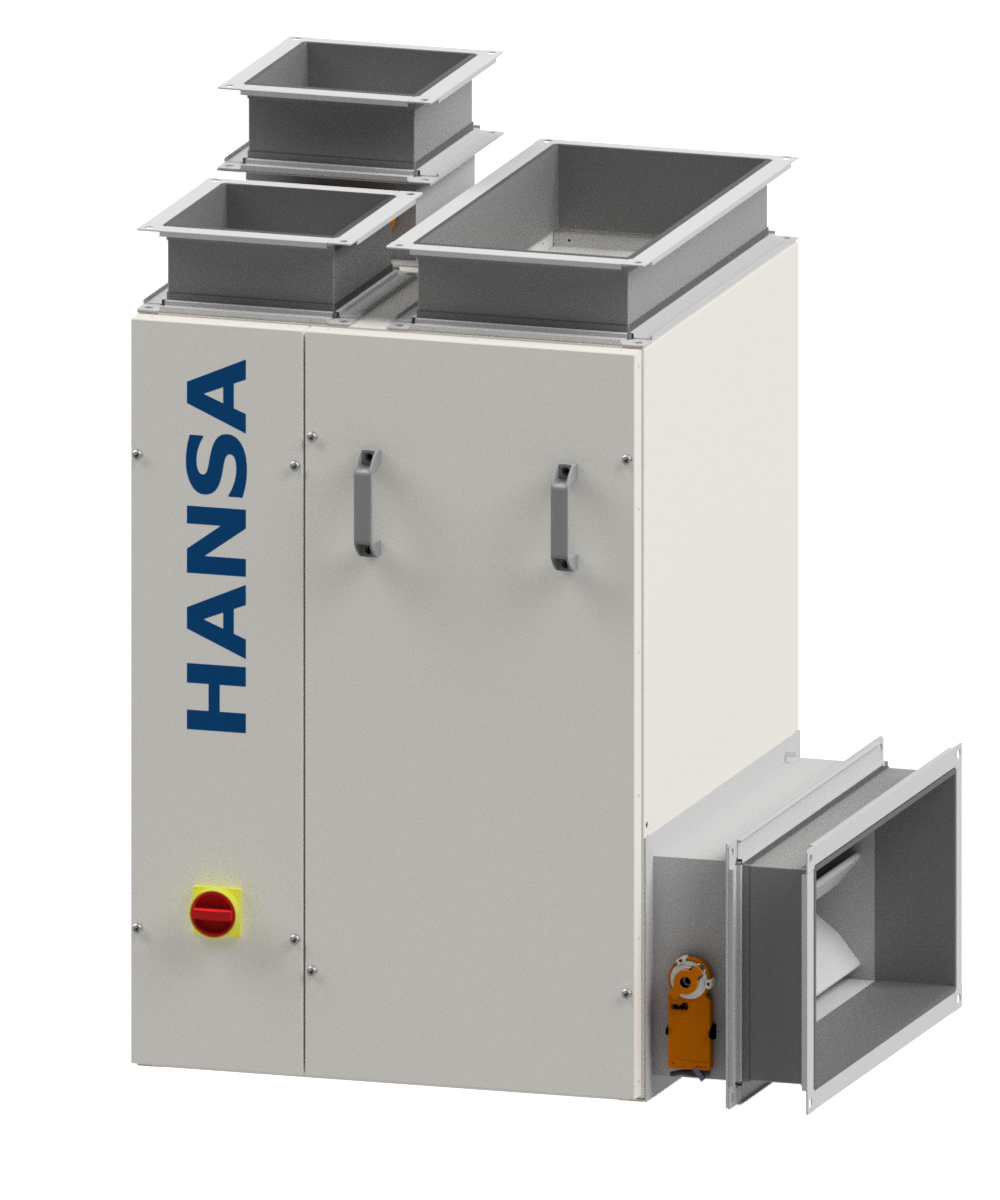
Free Line Air Handling Units
Customized air handling units for heat removal and demanding air-conditioning applications
Free Line HVAC units are designed for applications in which high heat or process loads must be reliably removed and air conditions specifically tailored to the respective task. Unlike HVAC systems with conventional heat recovery, the focus here is on flexible airflow and air treatment.
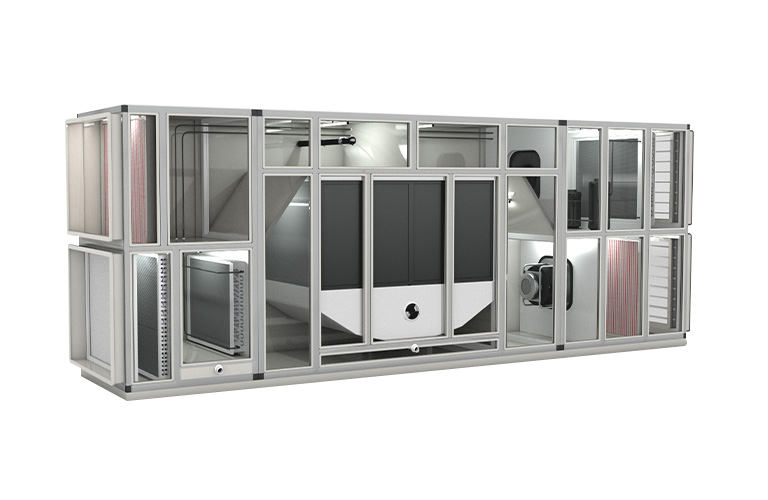
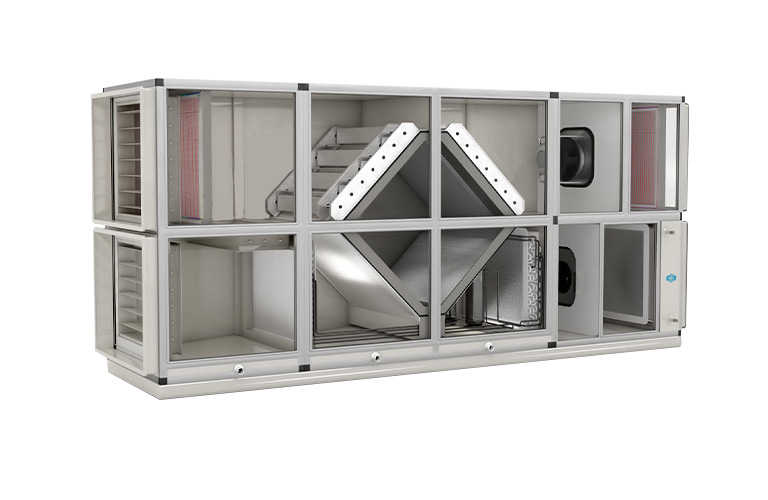
Depending on the application, Free Line units can be configured as supply/exhaust, mixed-air, or recirculation systems. Filtration, cooling, heating, and humidification, as well as various cooling concepts, can be combined to meet the required room or process conditions. Dimensions, components, and unit design are tailored to the specific task on a project-by-project basis.
For heat removal tasks with high heat loads year-round, direct free cooling additionally offers significant energy-saving potential: If outdoor air conditions are suitable, outdoor air can be used directly for cooling. Mechanical cooling is only required when the necessary supply air conditions can no longer be achieved with outdoor air alone. This principle makes Free Line particularly attractive for IT cooling—that is, the climate control of data centers—as well as for industrial heat removal and process applications.
Free Line units can be configured for air flow rates of up to 65,000 m³/h. In addition, customized solutions are possible depending on the specific project conditions.
Free Line offers maximum flexibility in airflow, air treatment, and cooling concepts—tailored to the specific heat removal or climate control task.
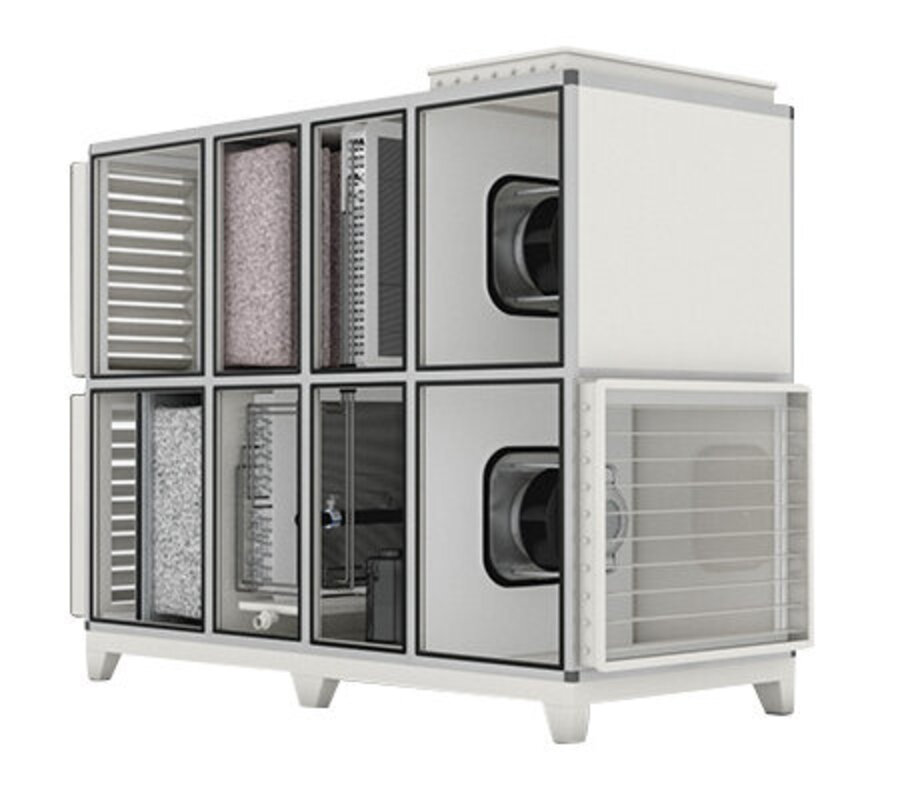
Free Line at a Glance
| Feature | Free Line |
|---|---|
| Unit Concept | Project-specific configurations of supply/exhaust, mixed-air, and recirculation units |
| Airflow | Up to 65,000 m³/h; higher capacities available on a project-specific basis depending on the operating conditions |
| Airflow | Outdoor air, exhaust air, mixed air, and recirculation modes can be combined as needed |
| Cooling | Direct free cooling, integrated mechanical cooling or chilled water coils—depending on the application and system design |
| Waste Heat Recovery | Exhaust air can be equipped with brine or evaporator coils for waste heat recovery using a heat pump connected in parallel |
| Air Treatment | Filtering, cooling, and mixing; heating and humidification can be integrated optionally or on a project-specific basis |
| Enclosure quality | Depending on the model, up to T2 / TB1 / D1(M) / L1(M) |
| Corrosion Protection | Project-specific up to C5-H; stainless steel and aluminum versions available |
| Installation | Indoor installation, outdoor installation, or rooftop control center |
| Sensors | Measurement of filter pressures and airflow rates, as well as temperature and humidity in supply, exhaust, and outdoor air; additional sensors available upon consultation and per customer request, e.g., particle measurement |
| Control & Automation | HANSA DDC with control panel; control strategy tailored to the unit, application, and operating mode |
Free Line Concepts for Various Tasks
Free Line is not a rigidly defined unit concept. Air distribution, cooling, and other air-handling functions are combined according to the specific application. Different system designs result depending on whether outside air can be used for heat removal, a high proportion of recirculated air is required, or supply and exhaust air need to be handled separately.
What they all have in common is a project-specific design based on the heating load, required air conditions, operating mode, and structural constraints.
In applications with high heat loads year-round, suitable outdoor air can be used directly for heat removal. Depending on outdoor and indoor air conditions, Free Line utilizes outdoor air, mixed air, or recirculated air for this purpose.
As long as outdoor air conditions are sufficient, the required cooling capacity can be provided without mechanical cooling. If the outdoor temperature rises, the proportion of outdoor air is first adjusted accordingly, and mechanical cooling is added as needed. Under outdoor conditions where a high proportion of outdoor air is no longer energy-efficient, the system can operate primarily or entirely in recirculation mode.
This concept is particularly well-suited for applications with high sensible heat loads and long cooling operating times, such as in IT cooling or industrial heat removal tasks.
At a glance:
Free Line Mixed-Air Operation with Cooling
Click it!
- Direct use of suitable outdoor air for heat removal
- Demand-controlled operation using outdoor air, mixed air, and recirculated air
- Mechanical cooling only as needed
- Integrated cooling system or chilled water cooling available
- Particularly suitable for facilities with high heating loads year-round
Not every Free Line application requires supply and exhaust air. In recirculation applications, the room or process air is passed through the HVAC unit, treated, and then returned to the room.
Depending on the application, different treatment stages can be combined—for example, filtration, cooling, heating, or humidification. Cooling can be provided via a chilled water coil or an integrated mechanical cooling system.
This makes Free Line suitable even for applications where high internal heat or process loads must be removed or defined air conditions must be maintained, without outdoor air exchange being the unit’s primary function.
At a glance:

- High air circulation capacities can be customized for specific projects
- Filtration tailored to the application
- Cooling via chilled water or a mechanical cooling system
- Heating and humidification optional
- Additional sensors, such as particle measurement, can be integrated
- Suitable for industrial, laboratory, and cleanroom applications, as well as energy facilities
Free Line can also be configured as a separate supply and exhaust air system. This is particularly suitable, for example, when the airflows for heat removal need to be routed separately due to spatial or structural constraints, and a mixed-air or recirculating airflow system is either undesirable or impractical.
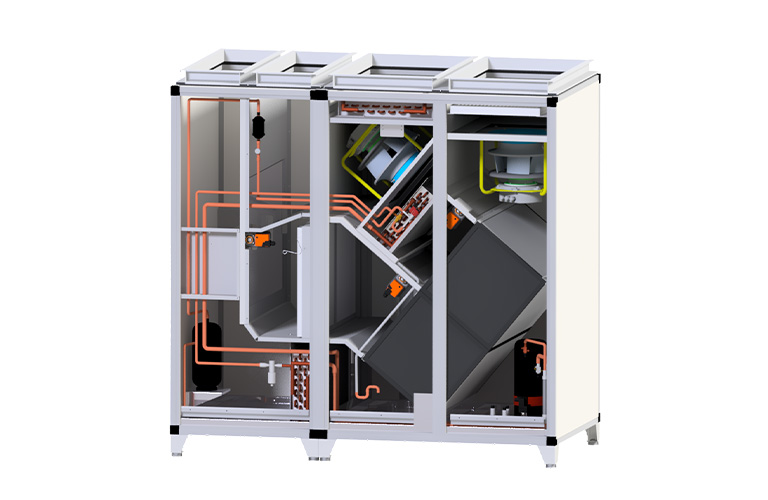
If the energy from the exhaust air is to be utilized nonetheless, the exhaust air unit can be equipped with a brine or evaporator coil. In combination with a heat pump connected in parallel, the available waste heat can thus be harnessed for other thermal applications.
This design thus allows for complete spatial separation of the units and air ducts without having to forgo the energy recovery from the exhaust air.
At a glance:
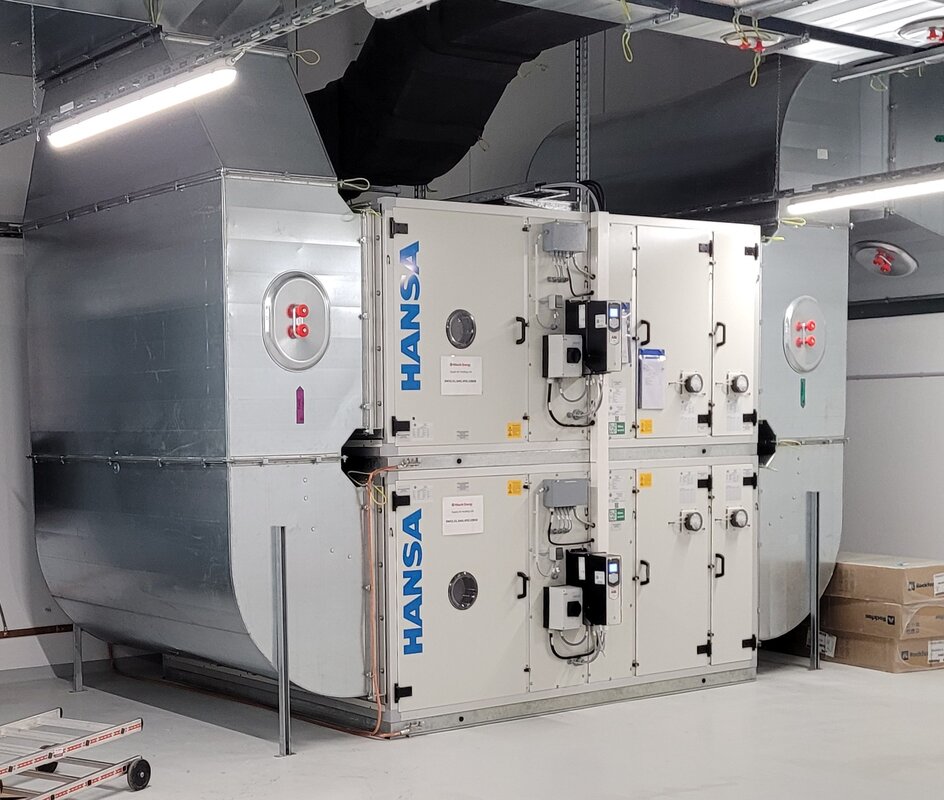
- Separate supply and exhaust air units
- Location-independent installation
- No direct connection between airflows
- Waste heat recovery via brine or evaporator coils possible
- Integration of a heat pump connected in parallel
- Air handling and equipment for both units tailored to the specific project
The concepts shown are not fixed device types. Free Line is configured according to the specific task. Combinations and variations are also possible if project requirements call for them.
Why Choose HANSA's Free Line Air Handling Units?
Maximum flexibility for customized HVAC applications
Free Line does not follow a rigid unit design. Airflow, air handling, cooling, dimensions, and features are configured according to the specific application. This results in supply/exhaust, mixed-air, or recirculation units that are specifically tailored to the required room or process conditions.
Efficiently dissipating high heat loads
Free Line is particularly well-suited for applications where high sensible heat or process loads must be reliably dissipated. Depending on the system design, cooling can be provided by suitable outdoor air, a chilled water coil, or an integrated mechanical refrigeration system.
Where outdoor air conditions allow for direct free cooling, the need for mechanical refrigeration can be reduced or, at times, completely eliminated.
More Than Just Cooling
In addition to heat removal, Free Line can perform other air-handling tasks. Filtration, heating, humidification, and various ratios of outdoor, mixed, and recirculated air can be combined according to the application.
This makes Free Line suitable not only for IT infrastructures but also for industrial processes, laboratory and cleanroom applications, as well as other tasks involving high internal loads or special requirements for indoor air quality.
Utilizing Waste Heat—Even Without Conventional Heat Recovery
Even in heat removal applications, the energy contained in the exhaust air can be specifically utilized. Exhaust-air-side brine or evaporator coils, in combination with a heat pump, enable the extraction and further utilization of the available waste heat without compromising the Free Line unit’s primary cooling function.
Built for the Installation Site and Environment
Free Line is adapted to the project not only functionally but also in terms of design. Indoor installation, weatherproof outdoor installation, or rooftop units are all possible, as are enhanced corrosion protection up to C5-H, as well as stainless steel and aluminum versions.
Enclosure ratings up to T2 / TB1 / D1(M) / L1(M) enable high-quality unit designs even for demanding operating and environmental conditions.
Controls Tailored to the System Concept
The more flexible an HVAC concept is, the more important it is to have a control system tailored to it. HANSA can therefore supply Free Line, including DDC, control panel technology, sensors, and user interfaces.
The control strategy is tailored to the specific unit configuration and operating mode. Additional measured variables—such as particle concentrations—can be incorporated into the control and monitoring concept on a project-by-project basis.
Free Line combines flexible airflow, customized air treatment, and project-specific cooling concepts in a single HVAC unit that is consistently designed for the specific application.
Free Line Air Handling Units in Use
Free Line HVAC units are used wherever high heat or process loads need to be removed and air conditions must be specifically tailored to the task at hand. The project-specific configuration of airflow, cooling, and air treatment enables solutions for a wide range of requirements—from IT infrastructures and industrial applications to laboratory and cleanroom environments.


Good to Know
Free Line is particularly well-suited for HVAC applications that require the removal of high, sensitive heat or process loads. Depending on the application, the unit can be operated using outdoor air, mixed air, or recirculated air and equipped with the necessary air-handling stages.
Typical applications include IT cooling, industrial and manufacturing settings, as well as laboratory and cleanroom environments. However, it is not the application area alone that is decisive, but rather the specific task at hand.
The starting point is the specific cooling or air-conditioning task. This includes, among other things, the heat load, required air conditions and air volumes, desired operating modes, existing refrigeration supply, as well as installation and environmental conditions.
Based on this, the system concept is defined in collaboration with the designer and operator. In subsequent coordination steps, the airflow path, cooling concept, air-handling stages, sensor systems, control systems, dimensions, and design specifications are finalized.
Once the order is placed, the unit is manufactured and delivered according to the agreed-upon configuration. Integration into the overall system is carried out in collaboration with the system integrator; HANSA can then take over the commissioning and tuning of the unit and control functions.
In many Free Line applications, the primary task is to remove heat from a room or process. To achieve this, the supply air must, of course, be introduced at a cool temperature. A conventional heat recovery system, which transfers the heat extracted from the warm exhaust air back to the supply air, would counteract this cooling objective.
The energy contained in the exhaust air can nevertheless be valuable. Heat can be extracted via an exhaust-air-side brine or evaporator coil and made available, for example, to a heat pump connected in parallel for further use.
In this way, cooling and waste heat recovery are decoupled: The supply air remains as cool as possible, while available heat can be utilized where there is an actual need for it.
If outdoor air conditions are suitable, Free Line can use cool outdoor air directly for heat removal. Depending on outdoor and indoor air conditions, the required proportion of outdoor, mixed, or recirculated air is regulated. Mechanical cooling is only used to meet the additional cooling demand.
The extent to which free cooling can be utilized depends, among other factors, on the location, required supply air conditions, and operating mode. Therefore, a blanket percentage cannot be applied to every project.
See also: Direct Free Cooling and Operating Modes in the IT Cooling Wiki
The appropriate option depends on the existing infrastructure, the required cooling capacity, the operating conditions, and the system design. For integrated refrigeration systems, the requirements of the F-Gas Regulation (EU) 2024/573 must also be taken into account.
Yes. Free Line is not limited to an outdoor/exhaust air concept with free cooling. For specific applications, the unit can be configured as a recirculating unit to specifically filter, cool, heat, or humidify room or process air.
This is particularly useful, for example, in industrial applications as well as in laboratory and cleanroom environments, where high internal loads must be dissipated or specific air conditions must be maintained. Filter stages, sensors, and other components are designed according to the specific application.
For applications with high availability requirements, Free Line can be integrated into redundant system designs. Depending on the required availability and cooling load, for example, multiple units can be configured so that, in the event of a unit failure or during maintenance, the remaining units take over all or part of the required cooling capacity.
The number of units installed is not the only decisive factor here. The control strategy must also be tailored to the redundancy concept. It must detect the operating states and malfunctions of the units involved and, if necessary, control the available units accordingly. At the same time, operating time should be distributed sensibly among the available units so that redundancy is not merely installed but is actually available during operation.
Which redundancy—for example, N+1 or 2N—is required depends on the required availability, the application, and the overall system design.
Learn more about redundancy concepts, N+1, 2N, and availability in the IT Cooling Wiki.
Free Line units are frequently used in applications where heat removal or the maintenance of defined room and process conditions must be ensured on a continuous basis. Regular maintenance therefore not only promotes energy efficiency and preserves the unit’s value, but is also a key component of operational safety.
Components relevant to maintenance—such as filters, fans, dampers, coils, sensors, and, where applicable, the integrated refrigeration system—must be inspected and maintained in accordance with operating conditions. For this reason, accessibility, installation location, and required maintenance space are taken into account in the project-specific design of the units.
Particularly for redundant systems, the maintenance strategy should be considered as early as the planning phase. A redundant unit design makes it possible to take individual units out of service selectively for maintenance work without necessarily losing the entire cooling capacity. This requires appropriate sizing as well as a control system that takes the maintenance status into account and coordinates the remaining units as needed.
HANSA can also provide maintenance and service support for the units beyond the commissioning phase.